





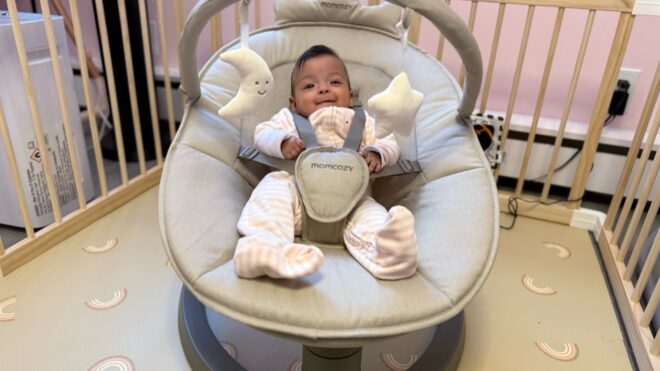
Ready to open your baby's mouth to a whole new world of textures and tastes? Is baby ready to open her mouth? Get ready for the joys – and the mess – of eating solid foods. When you begin feeding your baby solid foods you want to progress in a way that sets baby up for healthy eating habits. You are not only putting food into your baby's tummy, you are introducing lifelong attitudes about nutrition. Consider for a moment that during the first year or two you will spend more time feeding your baby than in any other interaction. You both might as well enjoy it.
WHY WAIT? 6 REASONS
Gone are the days when pressured mothers stuffed globs of cereal into the tight mouths of reluctant six-week-olds. Nowadays parents feed their baby on the timetable that is developmentally and nutritionally correct -- as determined by their baby. Don't be in a rush to start solids. Here are some good reasons for waiting.
1. Baby's intestines need to mature. The intestines are the body's filtering system, screening out potentially harmful substances and letting in healthy nutrients. In the early months, this filtering system is immature. Between four and seven months a baby's intestinal lining goes through a developmental growth spurt called closure, meaning the intestinal lining becomes more selective about what to let through. To prevent potentially-allergenic foods from entering the bloodstream, the maturing intestines secrete IgA , a protein immunoglobulin that acts like a protective paint, coating the intestines and preventing the passage of harmful allergens. In the early months, infant IgA production is low (although there is lots of IgA in human milk), and it is easier for potentially-allergenic food molecules to enter the baby's system. Once food molecules are in the blood, the immune system may produce antibodies to that food, creating a food allergy . By six to seven months of age the intestines are more mature and able to filter out more of the offending allergens. This is why it's particularly important to delay solids if there is a family history of food allergy, and especially to delay the introduction of foods to which other family members are allergic.
2. Young babies have a tongue-thrust reflex . In the first four months the tongue thrust reflex protects the infant against choking. When any unusual substance is placed on the tongue, it automatically protrudes outward rather than back. Between four and six months this reflex gradually diminishes, giving the glob of cereal a fighting chance of making it from the tongue to the tummy. Not only is the mouth-end of baby's digestive tract not ready for early solids, neither is the lower end.
3. Baby's swallowing mechanism is immature. Another reason not to rush solids is that the tongue and the swallowing mechanisms may not yet be ready to work together. Give a spoonful of food to an infant less than four months, and she will move it around randomly in her mouth, pushing some of it back into the pharynx where it is swallowed, some of it into the large spaces between the cheeks and gums, and some forward between the lips and out onto her chin. Between four and six months of age, most infants develop the ability to move the food from the front of the mouth to the back instead of letting it wallow around in the mouth and get spit out. Prior to four months of age, a baby's swallowing mechanism is designed to work with sucking, but not with chewing.
4. Baby needs to be able to sit up. In the early months, babies associate feeding with cuddling. Feeding is an intimate interaction, and babies often associate the feeding ritual with falling asleep in arms or at the breast. The change from a soft, warm breast to a cold, hard spoon may not be welcomed with an open mouth. Feeding solid foods is a less intimate and more mechanical way of delivering food. It requires baby to sit up in a highchair – a skill which most babies develop between five and seven months. Holding a breastfed baby in the usual breastfeeding position may not be the best way to start introducing solids, as your baby expects to be breastfed and clicks into a "what's wrong with this picture?" mode of food rejection.
5. Young infants are not equipped to chew. Teeth seldom appear until six or seven months, giving further evidence that the young infant is designed to suck rather than to chew. In the pre-teething stage, between four and six months, babies tend to drool, and the drool that you are always wiping off baby's face is rich in enzymes, which will help digest the solid foods that are soon to come.
6. Older babies like to imitate caregivers. Around six months of age, babies like to imitate what they see. They see you spear a veggie and enjoy chewing it. They want to grab a fork and do likewise.
How will I know when my baby is ready for solids?
As with all aspects of parenting, watch your child and not the calendar. Besides the developmental milestones above, watch for these ready-to-eat cues in your baby:
- Able to sit with support, reaches and grabs, and mouths hands and toys
- Watches you eat, following your fork as it moves from plate to mouth
- "Mooches," reaching for food on your plate
- Mimicks your eating behaviors, such as opening her mouth wide when you open your mouth to eat. Grabbing your spoon is not a reliable sign of feeding readiness, since baby may be more interested in the noise, shape, and feel of your utensils rather than the food stuff on them.
- Baby can show and tell. Around six months of age babies have the ability to say "yes" to wanting food by reaching or leaning toward the food and "no" by pushing or turning away. Expect mixed messages as your baby learns to communicate. When in doubt, offer, but don't force.
Does baby seem hungry for additional food? If your baby is content with breastmilk or formula, no need to complicate his life with solids. If, on the other hand, your baby seems unsatisfied after a feeding, is shortening the intervals between feedings, and several days of more frequent feedings don't change this, it may be time to begin.
I'm not sure if my baby is ready. Should I try offering solids anyway?
Is your baby both ready and willing to try solid foods? Here's how to tell. If your baby eagerly opens his mouth when he sees a spoonful of food coming toward him, he is probably both ready and willing. If he turns away, he's not. Or, give him a spoon to play with to see if it quickly ends up in his mouth. (Feeding tip: use plastic spoons with smooth, rounded edges. They do not get too cold or hot, and they are quiet when banged or dropped.) Remember, your immediate goal is to introduce your baby to solid foods, not fill him up on solids. Milk feedings will continue to be a major part of his diet for the next several months. Gradually introduce baby to a different texture, taste, and way of swallowing. Overwhelming your child with big globs of too many new foods all at once invites rejection. At this point, solids are add-ons, not substitutes for the breast or bottle. However, if you have a six- to nine-month-old formula-fed baby who is taking forty ounces a day, you may consider substituting a solid food feeding for a bottle.
NUTRITIP: Favorite First Foods
We started him on Solids at a little before he was 4 months old and took it well.
But then again, I was born and raised in Europe and I have learned that things are being handled very much differently from country to country. Food given to 4 months olds over there would not be an option here, and things given to babies here is something I hanet seen as baby foods there yet.
So its also about how you were raised youself and thats the way you may be continuing to raise your own kids.

Bradley Method Instructor,
"The Safest Way To Have A Baby"
Quoting Danielle8207:
Can I be honest? I exclusively breastfed for 6 months before introducing solids. I had a big baby from birth 9lb 1oz.- anyway... so I waited and from about 4 months until I started solids at 6 months he was sooo cranky! I could not figure out what was wrong! I was giving him Tylenol thinking it was really bad teething pains.... but the second I started giving him solids he has been SO much happier! Like a new baby! Not cranky at all! I wish I had started solids sooner, I think his little tummy needed a little something more. Although I know it's great to wait for their tummys to mature, I think in this case I wish I would have done differently...
I wanted to wait until 6 mo's... and honestly will prob try to for my next child (and the one after & so on) but it just didn't happen w/ Kalila. At 4 mo's (of being ebf too) she was more than ready... I could tell & could not not start her... It's been a month now & she's doing great on them. & still bf's very well... I'm not upset w/ myself for going ahead... would not have done it differently. But I have seen babies given solids WAY too early too... and that makes me a little sad/nervous.
Quoting MamaKalila:Quoting Danielle8207:
Can I be honest? I exclusively breastfed for 6 months before introducing solids. I had a big baby from birth 9lb 1oz.- anyway... so I waited and from about 4 months until I started solids at 6 months he was sooo cranky! I could not figure out what was wrong! I was giving him Tylenol thinking it was really bad teething pains.... but the second I started giving him solids he has been SO much happier! Like a new baby! Not cranky at all! I wish I had started solids sooner, I think his little tummy needed a little something more. Although I know it's great to wait for their tummys to mature, I think in this case I wish I would have done differently...
I wanted to wait until 6 mo's... and honestly will prob try to for my next child (and the one after & so on) but it just didn't happen w/ Kalila. At 4 mo's (of being ebf too) she was more than ready... I could tell & could not not start her... It's been a month now & she's doing great on them. & still bf's very well... I'm not upset w/ myself for going ahead... would not have done it differently. But I have seen babies given solids WAY too early too... and that makes me a little sad/nervous.
For her first "vegetable" (fruit really), we gave her fresh avocado that was blended and thinned with milk. The grandmas are kind of freaking out though - they think avocado is too exotic and that it will give the baby allergies! Did any of you try avocado early on with your babies?
Andrea
Quoting collegemama:
I wanted to start maya on solids at four months because she was more than ready (showing all the signs - imitating chewing when we sat down to eat, sitting up and holding head steady, and everything else) so I gave her some rice cereal and she ate like she had been eating from a spoon her entire life. But I didn't give her any more because I hadn't asked the doc and i'm a first time mommy with worries of allergies and all that stuff. So at her appointment the doc said to wait till after her 6mo appointment to see if I should give her solids because on breastmilk alone she weighed 21lbs at 4mo. and the doc didnt want to add more weight with solids. But it's been a struggle for us because she so badly wants to eat with us. She grabs at our plates and she even dipped her toy in my yogurt and tried to eat it but got it all on her face instead. She's cranky a lot and not teething (i check twice a day to make sure but no redness or drooling) and soooo interested in what we eat. I hope the doc lets me try solids at 6mo cuz she's ready for solids in my opinion. I'm so glad there's this group because my mom made all of her own baby food and I intend to do the same!
Mommy of Trevor D and Wifey of Christopher D
My baby!!!!! My soldier!!!!!!
-
'Teen Mom' Maci Bookout Shouldn't Lose Custody of Bentley
- Kate Moss Baby Keeps 'Beautiful People' Race Alive
- Arsenic Found in Organic Baby Formula: Is It Your Brand?
- Grant Wilson Leaving 'Ghost Hunters': Let's Watch His Creepiest Moments (VIDEOS)
- Randy Travis Arrest Video Will Make You Laugh -- Shame on You! (VIDEO)


- cali4niachef
on May. 7, 2007 at 1:18 PM