







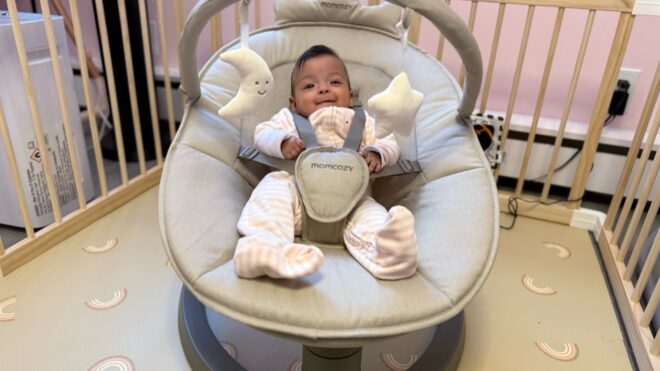
Ok, so I wasn't planning on even keeping my baby in my room with me. My and my SO made her a beautiful nursery! But after thinking about it, I've decided that it's just going to be easier to keep her in my room until she is sleeping more through the night, as to not disturb the other people in my house so much.
I was thinking about getting a bassinet or just co-sleeping, but the day I was discussing this with my mother, I opened my newspaper and found this article! Now I'm scared to co-sleep with my baby just in my bed with me, but I have a friend who mentioned a "co-sleeping pillow." I'm not sure what that is, or how you use it. Does anyone know anything about anything like this or something similar?
I'm not really set on co-sleeping or just buying a bassinet, just looking for some opinions? Help, please! :]
HOUSTON — At least 170 Texas children have died in the past year while sleeping with parents or an older child — far surpassing drowning, long thought to be a leading cause of accidental child deaths — according to statistics released Wednesday by Texas Child Protective Services.
“That translates to one child dying every other day,” said Patrick Crimmins, CPS spokesman.
After years of hearing anecdotes about such deaths from CPS caseworkers and paramedics, the agency instructed investigators to begin collecting data on child deaths that occurred in what authorities call a “co-sleeping” situation.
Any time a child was believed to have been suffocated while sleeping — either when an adult or older child rolled over on the smaller child or the child was pushed against a wall — the child's case was tagged.
Suspected cases were sent to Austin, where they were reviewed by investigators. None of the cases were criminally prosecuted because law enforcement officers found no reason to believe the children died from abuse or intentional neglect or homicide, Crimmins said.
Harris County had the most co-sleeping deaths in the state with 41, followed by Dallas County's 19. Bexar County came in third with 17, and Travis and Tarrant counties each had 13.
For years, local CPS officials and the Bexar County Child Welfare Board have spent thousands of dollars on cribs for babies whose families become involved with CPS. Bexar County Child Welfare Board Vice Chairwoman Yolanda Valenzuela said the campaign has been a priority because of local child deaths.
“We deplete our budget every year to buy these cribs and there is always a waiting list,” Valenzuela said, adding the reasons why people sleep with babies are both financial and cultural. “Yes, a certain percentage of the time it will be OK,” she said, “but often it's not worth the risk.”
Bexar County CPS spokeswoman Mary Walker said caseworkers assess the sleeping arrangements for babies, but said the department mainly stresses safety.
“We're just asking parents to be safe when they do it,” Walker said. “They shouldn't be under the influence of alcohol or any kind of medication, or if they are overly exhausted — all of that puts them at risk.”
Texas CPS officials began collecting the information to create a baseline on the problem and to begin bringing the issue to the public's attention.
Although state officials would not release cause-of-death information in these cases — which occurred between Sept. 1, 2007, and Aug. 31, 2008 — they acknowledged that the primary danger in a co-sleeping situation is suffocation.
“We aren't saying how they died,” Crimmins said, citing the agency's practice of not disclosing a dead child's name. “But we are saying they were co-sleeping when they died.”
In more than half of the cases this year, the infants died before they were 3 months old. In a third of the cases they were between 3 and 7 months, and about 10 percent of the children were older than 6 months. The oldest child was 22 months.
CPS released basic information about a few of the deaths to give the public a better idea of the issue.
For example, in San Antonio, a 2-month-old girl died Aug. 12 while sleeping with her mother and two siblings. The girl was found trapped on top of the box spring between the mattress and the wall.
On June 12 in Baytown, a 1-year-old boy died while sleeping in a twin bed with his mother while visiting a relative.
On March 1, a 6-month-old in Houston died while sleeping in a bed with his 3- and -4-year-old siblings. The three were sleeping on two twin mattresses shoved up against a wall.
Accompanying the numbers was an advisory to the public about how to safely sleep with a child. Some experts believe sleeping with infants creates a better bond, and state officials stressed they were not criticizing the practice, merely pointing out the dangers.
“There are parents who believe in the value of co-sleeping,” said Doug McBride, spokesman for the Texas Department of State Health Services. “There are some pluses. There are some disadvantages.”
Express-News Staff Writer Nancy Martinez contributed to this report.
**The article is basically says that in the last year 170 children died in Texas because of co-sleeping...
sorry! I know it's long! I didn't mean to read it before responding...I'm just trying to decide what to do!
I didn't read the article...sorry. BUT wanted to say that I co slept with my daughter until she was about 4 months old. I loved it. She is now 2 and still climbs into bed with us in the middle of the night. When she was a baby she just slept between hubby and I...but since she is still climbing into bed, I felt it safer for the new baby to sleep in a cosleep that attaches to the bed...so that is what we are going to do. Co sleeping is great for nursing mothers. I love it.
I did have my daughter sleep with my husband and I, however I lways had her on my side becasue I knew he was to deep of a sleeper to acknowledge her there. I can honestly say I caused myself less sleep, nesk and back pains being cautious of her there. SO, I put her pack n play next to the bed and it was much better. She was still in my room, half and arms length away and I slept soundly knowing nothing was going to happen to her. We love our kids and we want them right next to us so we know their safe unfortunately our best intentions sometimes turn out to be our worse nightmares. Put your child next to you in a safe pack n play or bassinet. You feel better that they are right there, but you can sleep soundly knowing you won't wake up on top of your child. I know it sounds impossible to do that but after extreme exhaustion, it's amazing what people have accidently done to their kids.
I kept my little one in a bassinet next to my bed for the first 2 months or so. He was literally an arms length away at all times and I really liked knowing that if he needed me I was right there. I was always nervous when I tried taking naps with him in our bed and neither of us slept as well as we could have because I was afraid to move and wake him and he would wake up whenever I moved. Very uncomfortable, so for us the bassinet was the perfect solution.
I know a lot of people that co-sleep, I have for over 6 years, myself. I like to look to history and the rest of the world as a guide. I see what has great benefits & incorporate it to my parenting whenever possible. :-)
This Patented Bed Top Co-Sleeping
Device
Makes Your Bed Sharing Experience
Safer And More Enjoyable!
![]() | |
| Price: | $199.99 |


~Carla Hartley, founder of Trust Birth and the Ancient Art Midwifery Institute
Treating normal labors as though they were complicated can become a self-fulfilling prophecy. ~Rooks
If you lay down, the baby will never come out! ~ Native American saying
I really think it depends on the parents and how heavy of a sleeper they might be. I'm a very light sleeper so I know that I could never roll over onto my baby, if I was a heavier sleeper I wouldn't have her in our bed just in case. But I do love co-sleeping, it's easy and she sleeps for 10 hours straight when she's in our bed (she's 2 months old) although when we do put her in her crin (on nights that we're feeling a little frisky, lol) she'll sleep for about 6 hours by herself. Anyway, I hope that helps some.
Wife to Kent, Mother to Kendal ![]()
![]()
I never thought about cosleeping. I know it works for some but DH and I are both heavy sleepers. I remember once we had to sleep with DD in the bed when we went on a trip and didnt bring anything for her to sleep in. DH woke me up cause I had rolled on her Arm. Never again. But we do have a bedside cosleeper. I used with DD and LOVE it. It attatches to your bed so there is no worry about pushing it away. And all you have to do is roll over and there is the baby. I kept everything I needed for the night in the side pockets anddidnt even have to get out of bed. This is the one we have from Target. But I am sure you can find them elseware for less.
Arm's Reach Mini Co-Sleeper Bassinet

I try not to co-sleep, but my son is only 9 days old. There's been a few nights so far that he won't sleep unless he's laying on me, or right next to me. Luckily I have a queen sized bed and really only sleep on the one side and don't roll to the other. I will admit I get less sleep with him in the bed, but propping him up in the boppy pillow seems to help him sleep.
I don't co-sleep with my daughters because I never felt comfortable having them in the same bed as me. Even though the bed is against one wall, I was always fearful of rolling on top of them. My daughters have their own rooms and cribs and have slept there since they were brought home. For me, having them sleep in their own beds got them used to sleeping by themselves. I don't want to have a battle every night when it's bedtime.
I would say that if you wanted to keep your baby close to you at night, maybe get one of those beds that attach to the side of your bed. That way the baby is close but not in your bed. It's your decision so you decide what's best for your family. What works for my family, doesn't mean it'll work for yours. Congratulations and good luck!
Reviewing study after study, the message is clear: The relative risk of death for infants sleeping in a safe adult bed with a safe parent is not greater than those found sleeping next to the parental bed, and their death risk is far smaller than those sleeping in a crib in another room. And, for infants over 2 or 3 months of age, the studies show a protective effect of co-sleeping over sleeping next to the parental bed.
Just as they once were in cribs, suffocation risks are apparent on adult surfaces. The clear message should be that the adult bed needs to be made safe without overly fluffy or heavy bedding, wedging dangers, overheating, siblings (with a very young infant), or drugged or drunk parents or parents who smoke. Sofa sleeping is not safe with babies. The message we get from the AAP?? Cosleeping is unsafe. Period. While breastfeeding is shown to reduce SIDS, breastfeeding is not mentioned, and interventions that can impede breastfeeding are promoted without appropriate substantiation.
Unfortunately, no studies bother to derive from their statistics a risk ratio for deaths of babies co-sleeping in a family bed with safe, non-smoking, sober parents and with reasonable efforts to reduce wedging and other suffocation dangers. From the available statistics, the full number can only be guessed at, but is clearly as safe or safer than the child sleeping in a crib in the same room as parents and, of course, far safer than sleeping in a crib in another room. Contradictory to the supposed goals of the AAP, it is clear that limiting safe cosleeping will not reduce SIDS.
Important
to understanding of quoted stats in the news...
When you hear these terms in the news:
The term "adult bed" usually includes dangerous sofas, sofa chairs, make-shift beds, and waterbeds, which account for a large portion of the adult-surface deaths. Also, it doesn't necessarily mean there is cosleeping. An infant sleeping alone on an adult bed is at greater risk than when with a protective parent. The use of such terms wrongly makes appropriate adult bed sharing sound dangerous.
"Bedsharing/cosleeping" statistics and comments usually include sleeping with any adult in any state (including over-exhausted, drunk, or drugged), with a smoking adult, or with another child, or multiples of these; and includes dangerous sofa sharing etc. ALSO, usually statistics are for having co-slept at any time during the night of death — not necessarily cosleeping at the time of death. Conscientious parents are scared away from safe cosleeping by such slanted reporting.
Notice that most studies lump all unexpected infant deaths as SIDS and some pose suspected suffocations as distinct from SIDS. The resultant stats will be quite different. While co-sleeping may reduce actual SIDS, the suffocation risks alone are greater for bed-sharing, (as great as they used to be in cribs before safety standards were taught), when appropriate precautions are not taken.
Additionally, a new risk-association with infant death in bedsharing is pointed out in a few studies that looked for it: the finding that possibly half of those dying while bedsharing were not accustomed to bedsharing, meaning, among other possibilities, that the parents or whomever were not experienced in protecting the baby from hazards, that the bedsharing was impromptu due to overtired or intoxicated parents, or that the baby may have had extra fussiness for some health reason and was brought to the parental bed for that reason. Why do no studies fully compare safe, conscientious cosleeping with other sleep situations? The results would reveal the safety and benefits of the family bed.
The numbers in the largest study on cosleeping around the world suggest that safe cosleeping reduces SIDS greatly! Most nations with SIDS rates much lower than the United States regularly practice cosleeping, on firm surfaces, with low rates of smoking. See graph at bottom.
Below are my summaries of key points from the largest and most-recent studies; a large portion of which come from the AAP's own journal, Pediatrics, and including all of the relevant studies referenced in the big October 2005 journal announcement, (or more-current reports from the same studies or authors).
Because the AAP, baby product industry, and media want you to hear only the sensationalized incomplete findings, I demonstrate what the studies truly found.


M. Lahr et al., "Bedsharing and Maternal Smoking in a Population-Based Survey of New Mothers" Pediatrics (U.S.) 116, no. 4 (Oct 2005): e530-42.
At the face, this is a study of smoking and cosleeping using 1867 women in Oregon, yet in this October 2005 study — in the issue just before that containing the big AAP announcement warning against all cosleeping — and published in the journal of the AAP the MD and PhD authors extensively analyze 9 large case-control studies of bedsharing and SIDS and additionally review several other studies as well.
These authors state that "Recommendations must be based on solid scientific evidence, which, to date, does not support the rejection of all bedsharing between nonsmoking mothers and their infants."
Birth is not only about making babies. Birth is about making mothers ~ strong, competent, capable mothers who trust themselves and know their inner strength.
~Barbara Katz Rothma
When you change the way you view birth, the way you birth will change. -Mongan


- Krysten309
on Nov. 28, 2008 at 11:08 PM